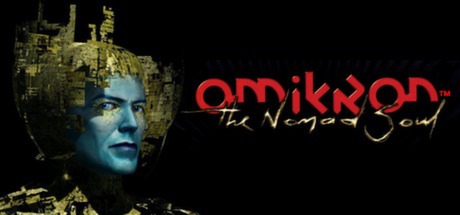
Concept:
Omikron: The Nomad Soul takes place in a “future past” much like Star Wars. And similar to the Star Wars universe, there are somewhat-explained mystical powers along with sci-fi weapons and robots. The “Earth” of this universe is Phaenon. Citizens of megacity Omikron are blissfully unaware of the evil lurking just beneath the streets.
Demons have been unleashed upon the world, and the leader of the demons, Astaroth, is building his strength by consuming souls. But, after doing this for years, the souls of the humans on Phaenon are withered and not providing the same power he needs. So, he is looking to parallel dimensions, and luring people in to steal fresh souls. It falls to you, the Nomad Soul, to stop Astaroth and his army from conquering the universe. You do this by hopping from body to body to get past obstacles and solve puzzles.
Also, David Bowie’s in it! He provided some songs for the soundtrack, plays the lead singer of The Dreamers and plays Boz, the virtual guardian.
How they fucked it up:
Pretty much from “Start New Game,” the whole thing falls apart. The first playable character breaks the fourth wall, saying that your screen is a portal between dimensions and he needs you, the player, to take over his body. Fourth wall breaks aren’t anything new in media. But, the way it is handled in this game is convoluted and a bit pretentious. The “this is real and this is happening” angle is brought up multiple times during the game. Characters will explicitly say that Astaroth is targeting gamers who are playing Omikron, and the game itself is a trap that will pull you into their dimension and steal your soul.
The obvious solution to this would be to stop playing and uninstall the game, then.
Next, the game can’t really decide what it wants to be. The plot starts as a futuristic murder mystery, becomes a supernatural “chosen one” story, turns into a “resistance army” action story, before bouncing back to chosen ones and prophecies. The lore of Phaenon and the characters is vast and complicated, which is good from a world-building standpoint. But, when you try to introduce the lore in everything from in-game notes to solutions to the puzzles, it results in lots and lots of exposition. In addition, there are so many massive plot twists and upheavals to the story that it cheapens the impact the further on you play. As one of my favorite livestreamers put it, to paraphrase, “David Cage is so fond of the third-act twist, that he has one in each act, and multiple in the third act.”
This indecision of game direction extends to the gameplay as well. By director/lead writer David Cage’s admission, he wanted to make a game that spanned and blended multiple genres. Primarily, the game is a third-person, open-world adventure. But, there are also two combat engines: a “spamming is better than combos” Mortal Kombat-esque fighter, and an overly sensitive first person shooter. These gameplay styles change abruptly during missions, causing the unprepared player to immediately fail, and in some cases, unable to try the mission again.
This rapidly shifting gameplay can make playing through the game frustrating, especially when the saving and extra lives system are taken into account. There are a limited number of save tokens in the game. Once you’re out, you’re out forever, and can’t save anymore. But, your save tokens also count as extra lives during the first person shooting sections, being deducted every time you die. And considering how irritatingly difficult the shooting sections get, you’re bound to lose a few unless you keep reloading the save. It hardly seems fair to have your finite save tokens also function as additional lives, especially when there is a possibility that you will end up spending a few trying to find more out in the world.
Lastly, the core gimmick of the game had a few hiccups. Having a changing protagonist with varying strengths was a fresh and interesting idea for the time, and many games since then have played with that concept (Watch Dogs: Legion, Project Zomboid, Rogue Legacy, etc.). But, the way this was implemented in Omikron isn’t great. First, it is explained to you that you automatically transfer bodies if the current body you are in dies. But, depending on who you’re fighting or where you are, you just get a “Game Over” if you die.
Then, you are introduced to the Reincarnation spell that lets you change into an available body at will. There are at least thirty bodies you can transfer into, all with differing stats and ideal times to use. The aim is to use a different body to bypass an obstacle or get information from a specific NPC. However, in the basic gameplay, you don’t need to transfer bodies often. For example, one of the levels involves you infiltrating a factory. You can go in as normal, or transfer into the body of a factory worker. Entering as any other body means you’ll be having a dandy little shootout. Using the factory worker means no one will attack you. You can finish the level either way. One way will just take longer than the other.
But, there are points in the game that force you to transfer into specific bodies, and one of those transfers didn’t need to happen plotwise (RIP Fodo the Sham Herder). To make matters worse, once you have transferred out of a body, you can’t use it again. Unless you use a guide, you aren’t going to immediately know which body is good to use for which scenario. Let’s say that you’re currently using the strongest guy in the game. The NPC you need to speak with will only talk to you if you’re a woman. So, you transfer into the nearby beautiful woman. Super strong guy is lost forever, and there’s gonna be a lot more fights to come. You must either slog through the combat in a weaker body, grind in the training room, or buy a bunch of level up items to build your strength back.
At the time of release, Omikron: The Nomad Soul had decent reviews. It had an interesting story, a good soundtrack, and a lot to offer in its world. But, as time has passed, people have fewer positive things to say. The graphics have aged poorly. The controls are a nightmare, even compared to other tank-controlling games of the time. The gameplay and story are all over the place. It seems the best way to play this game is with a guide, since a lot of solutions to the puzzles are unintuitive or have a single solution in a single location on the opposite end of the map. But, if you have a spoiler guide for more than a third of the game, what’s the point in trying to explore?
A lot of critics and consumers will agree that the game had a solid start, but after around 30 minutes, Omikron: The Nomad Soul falls apart. The 30 minute mark was also where the demo that was shown to investors stops.
That’s probably just a coincidence, though.
 Interesting Times with CaptainHoneydew
Leave a comment