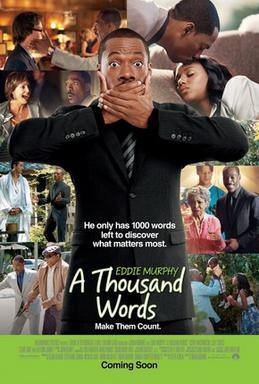
Concept: Jack McCall (Eddie Murphy) is a literary agent who lies and sleazes his way to getting a New Age guru (Cliff Curtis) to sign with him and sell his book. The guru knows Jack is full of shit, but signs anyway. That same night, a tree appears in Jack’s yard. Jack notices that for every word he speaks, a leaf falls from the tree. When the tree is completely bare, Jack will die. Jack needs to try and figure out how to fix this mess by using as few words as possible. Through this experience, Jack learns that the things he says have an impact, no matter how small they may seem.
How they fucked it up: A lying shithead needing to learn his lesson by having him forced to focus on what he is saying is a great concept. In fact, another movie did this concept much better: Liar Liar. But, where that movie succeeded, and A Thousand Words failed, lies with the lead actor’s versatility, the nature of the “curse,” and the more serious subjects at play.
The director of A Thousand Words is Brian Robbins, the same guy who directed Norbit and Meet Dave. Considering how well those were received should tell you something. Oddly, Nicolas Cage was a producer, too. …Maybe that’s not that odd. What results is a movie that was a product of the times, trying to be something more than what it was.
Casting Eddie Murphy and not allowing him to speak was one of the main criticisms of the movie. Murphy is known more for his verbal comedy than anything. Without verbal jokes, one can only rely on visual humor. While Murphy did/does do physical comedy, A Thousand Words played it very safe and conservative.
Large objects hitting a character, making weird noises, and weird charades aren’t as funny as the “I’m kickin’ my ass, DO YA MIND?!” scene. Liar Liar played into Jim Carrey’s strength in physical/visual comedy as well as his verbal delivery.
Not helping is when Murphy is allowed to speak, the things he’s saying aren’t funny. Until the curse is introduced, he’s talking a mile a minute, lying about his personality, and being a prick to his assistant and wife without any jokes that weren’t done a million times before (quoting “Soul Makossa” during chanting, lying about an emergency to skip lines, etc.).
In Liar Liar, the rules of main character Fletcher’s curse are pretty clear-cut, and can be summed up in one sentence; For 24 hours, Fletcher is physically unable to lie. The curse isn’t sidestepped with lying by omission or refusing to speak at all. The only “cheat” to the curse is Fletcher saying something true without realizing it.
The “rules” of the tree curse are very loosey-goosey. The curse should just be boiled down to one sentence; Jack will die after speaking or writing 1000 words. This should mean that gestures would be the only way for Jack to communicate. But, he finds that gestures (like nodding his head or throwing the bird) also reduce the number of leaves on the tree…but sometimes they randomly don’t because Jack keeps making gestures and movements to let people know what’s happening (like shaking his finger “no” or tapping his nose). While it makes sense that we wouldn’t be cutting to leaves falling off the tree every time he makes a series of gestures, we cut to the tree multiple times when he uses words during day 1 of the curse. Either he can use gestures to communicate or he can’t.
Also, whatever happens to the tree happens to Jack (cutting it makes Jack bleed, watering it makes him sweat, etc.) …but sometimes it doesn’t because birds land on it, and it gets watered again without anything happening to Jack. It’s like this rule of the curse only applies for “comedy.”
A Thousand Words was criticized for not handling the serious subjects well. Some of the messages the film is trying to get across fall flat when one thinks about it.
Accountability for one’s words/actions is a major one. In the case of Liar Liar, Fletcher comes to terms with the fact that him being cursed is entirely his fault due to how his lies affected his loved ones. The scene where he blurts out that he is a bad father is basically the point where he realizes the impact of his behavior. Fletcher’s actions are his own, and it falls to him to make things right when his curse is up.
In A Thousand Words, Jack realizes basically the same, that his lies and manipulations are negatively affecting his loved ones, and the curse laid on him is his own fault. The way to undo the curse is to “make peace” in his relationships with family and friends. You know how to improve a bad relationship with a loved one?
You communicate. With words. Not whatever the hell this was.
A secondary theme in A Thousand Words is forgiveness. A big part of why Jack was being so shitty was he was dealing with the trauma of being abandoned by his father. But, this isn’t given a lot of focus except for a 2-minute scene towards the beginning, a minute scene in the middle, and the lead-in to the big fake out at the end. The way Jack ultimately breaks his curse is to use what should be his last few words on forgiving his absentee father. This would be very touching if the absentee father hadn’t already died before the main plot started.
The onus being on Jack to “solve” the conflict between him and his father makes it seem like Jack being abandoned was his fault. A parent abandoning their young child is never the child’s fault. The only thing Jack needed to fix on his end was his treatment of his family and friends, since that’s what he had control over. One’s actions in response to their trauma is their responsibility, not the fact that they were traumatized to begin with. If anything, Jack needed to forgive and make peace with himself for treating everyone like shit, and accepting that they may not want to deal with him, even if he tries making things right.
I also have an issue with most of the characters being incredibly dense throughout the movie. Despite written words reducing his word count, Jack refuses to write anything down after discovering that fact. He literally could have held up a notepad to everyone he came across, saying, “I have bad laryngitis. Can’t speak for a few days.” 10 words, believable story, no problem. Jack’s wife refuses to consider that something might be wrong with her husband, considering he was a chatterbox one day and mute the second. Jack’s assistant is just an idiot in general, even when he realizes the extent of the curse. Probably the only person not being stupid is the guru.
Most of the cast is holding the idiot ball, and it’s frustrating to watch the same joke repeated over and over; Jack fucks up a situation because he can’t speak, and the person who is mad at him refuses to see or understand that something might be wrong with Jack.
A Thousand Words is one of the few movies to have the rare distinction of getting a 0% on Rotten Tomatoes. While there are a few funny bits here and there, and the scene where Jack contemplates his death on the boardwalk was surprisingly good, it’s not enough to salvage the rest of the movie. The jokes are predictable or just don’t add to a scene. The drama falls flat. The characters are idiots. A Thousand Words just isn’t for me; I’d rather just watch Liar Liar again.
I shouldn’t judge the people who like A Thousand Words too harshly, though. I’m one of the people who liked Norbit.
 Interesting Times with CaptainHoneydew
Leave a comment